
No water at 7am: how the tank, pump and pressure work in your home
By HabitaOne Team
It's 7 in the morning, you turn on the shower, and nothing falls. A trickle, then air. If you live in Venezuela, that scene doesn't catch you off guard: the water from the street arrives when it arrives. So the question of how to improve water pressure in a house rarely gets solved in the pipe outside. It gets solved indoors, with a tank, a pump, and a few parts almost nobody explains to you until they fail.
7 in the morning without a drop: why it happens
The trouble starts with thinking of water as a continuous service that sometimes "goes out." In much of the country it works the other way around: water comes for a few hours, on alternating days, or on a schedule only the neighborhood knows. Your house doesn't draw straight from the street. It stores water when it arrives and lives off that reserve the rest of the time.
So at 7 in the morning, nothing may come out for two very different reasons, and it pays to know which one is yours. One: you ran out of reserve, the tank is empty because no water has arrived for days or because you used more than came in. The other is more common than it looks. You have water stored, but nothing is pushing it, because the pump didn't start, the pressure tank lost its charge, or the system can't lift the water to the floor above.
Each case needs the opposite fix. Short on reserve, you need to store more. Short on push, you need a better pump or more pressure. Confusing the two is exactly what makes people buy a bigger tank when what they were missing was a decent pump.
How to tell which case is yours
Open a ground-floor faucet. If it comes out with good force but nothing does upstairs, you have water and the problem is pressure and push. If nothing comes out downstairs either, check the tank level first. Diagnosing this before you spend keeps you from buying the solution to a problem you don't have.
the parts: tank, cistern, pump and pressure tank
A home water system in Venezuela usually has four parts. Not every house has them all, and that goes a long way toward explaining why some homes never run out of water and others suffer every week.

The cistern is the big reserve, almost always underground or at ground level, where the street water lands when it arrives. It's the house's storage and your cushion for the days with no supply. The bigger it is, the longer you hold out when the street abandons you.
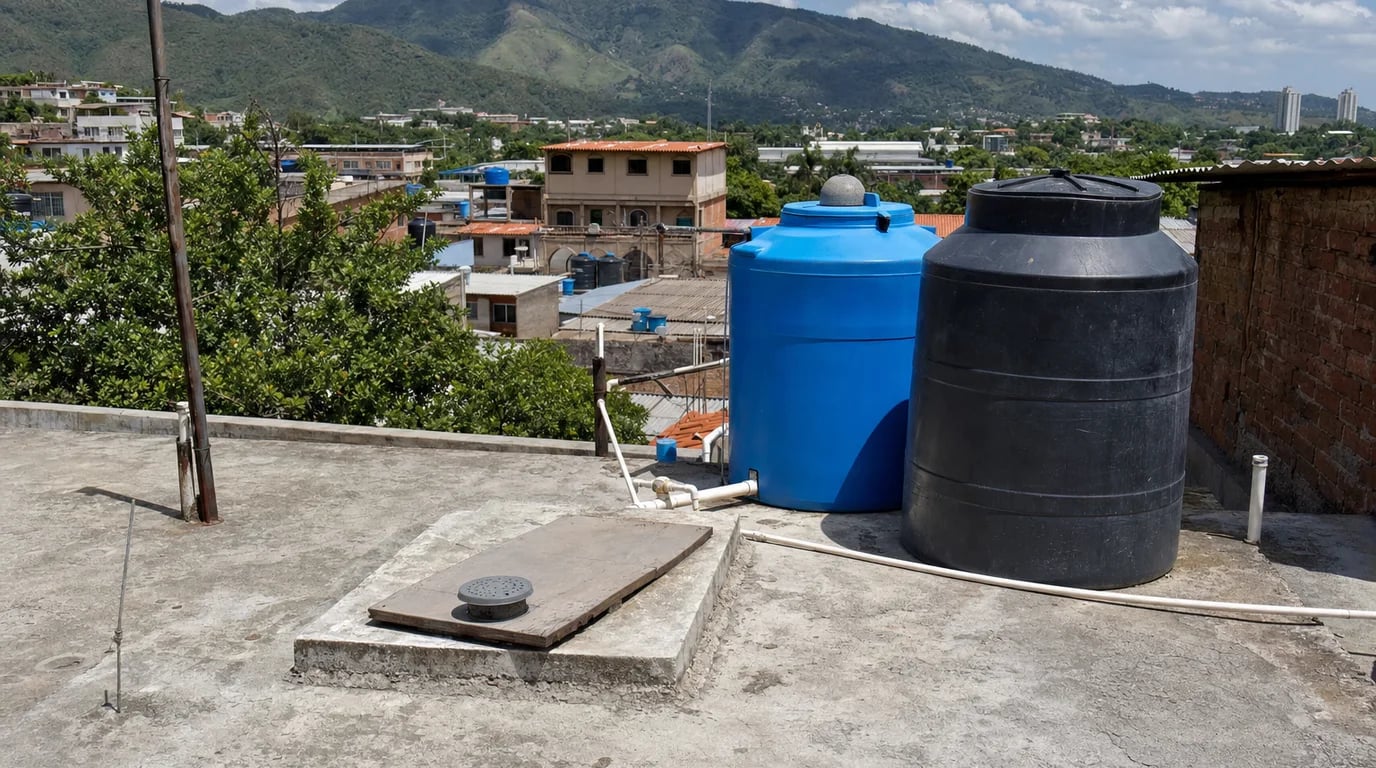
The tank is usually the daily-use reserve, the one that feeds the faucets. In many houses it's the elevated tank, mounted on a structure or on the rooftop, so a water tank for a house in Venezuela comes in two flavors: the big reserve one below and the use one up top. The right size depends on how many people live there and how many days of backup you want. A bigger tank won't improve pressure. It only buys you more autonomy.
The pump moves the water. It lifts it from the cistern to the elevated tank, or pushes it straight into the pipes. Without a pump you're at the mercy of gravity, which only reaches you if a tank sits high enough above the faucet you're opening. A pump that starts and stops nonstop, vibrates oddly, or no longer lifts the water like it used to is asking you for maintenance or replacement.
The pressure tank is the part most people have and fewest understand. It's a metal tank with compressed air inside, separated from the water by a rubber membrane. When the pump fills it, it compresses that air, and the air acts like a giant spring that sends water to your faucets at a steady pressure. That's why the pump doesn't start every time you open a tap: it works between two pressure limits, kicking on when pressure drops and shutting off when it rises, and in between the air does the pushing. That's what gives you a firm stream instead of water that pulses.
why the pressure goes weak, especially on the second floor
This is the part that sends so many people searching for how to improve water pressure on a second floor without understanding what's actually happening. Pressure is a fight against gravity. The water has to go up, and going up costs.

If the water reaches your house by gravity alone, from an elevated tank, the force it comes out with depends on how high that tank sits above the faucet. On the ground floor it usually reaches. On the second floor, where the tank sits barely above the showerhead, the height difference is small and the stream comes out weak. You're not short on water. You're short on height, and height is what turns into pressure.
The causes repeat in almost every house. The tank sits too low relative to where you use the water and gravity alone can't do it. There's no pressure tank, or the one there lost its air and stopped pushing. The pump is small or already worn out. The pipes are old, narrow, and scaled up, and they choke the flow. Sometimes it's one of these. Often it's several at once.
And here's a detail most people overlook: pressure and the amount of water are not the same thing. You can have the tank full to the brim and still have a shower that barely wets you, because water you have to spare and push you don't. Storing more water won't fix that. Improving what moves the water will.
A full tank guarantees you nothing if there's no one to push that water up to your showerhead with force.
the solutions, from cheapest to most expensive
There's almost always a way out, and it's almost never the most expensive one. Work from the smaller investment to the larger, because a good share of the time the problem gets solved before you reach the big spend.

The cheapest move is to check what you already have. A pressure tank that lost its air charge can be recharged, and the pressure often comes back just by topping up the air through the valve, the same way you inflate a tire. A pump that starts every few minutes may need that same adjustment. Before buying anything, have someone who knows check whether what's installed is working right or fell out of calibration.
The next step, if you don't have a pressure tank, is to install one. It's the part that changes daily life the most. It stabilizes the pressure, keeps the pump from switching on and off all day, and gives you that firm stream that feels like a different house. A pressure tank for a house in Venezuela comes in many sizes, and the right one depends on how many bathrooms and how many people the home has, so ask for advice before buying the first one you see.
If the pump is the bottleneck, the change is to one with more capacity, or to a booster pump built to push water up to the higher floors. The biggest investment, when none of the above is enough, is to raise or enlarge the elevated tank to gain height, or to upgrade the pipes if they're old and clogged. That last one is construction work, not a spare part, which is why it's left for the end.
Don't start with the most expensive
The classic mistake is buying a bigger tank or tearing out pipes when the problem was a pressure tank with no air or a pump out of calibration. Diagnose first, spend later. The expensive solution is almost never the first one you need.
what to check about the water before you move in
When you're going to buy or rent, the water system deserves the same attention as the title or the solvency certificates, because it's what you'll live with every day. A beautiful house with no good reserve and no decent pressure is a nuisance that doesn't show up in the photos.

Ask and check, in this order. How does the water reach the area: by pipe, by schedule, by water truck? How many days of reserve does the house's storage give you if supply stops? Is there a pump, what type, and when was it last serviced? Does it have a pressure tank, and does the pressure reach the highest point of the home properly? Open the faucets on the upper floors and see it for yourself. Don't settle for the seller's "yes, it comes out fine."
In buildings and complexes almost all of this is shared: the tank, the pump, and the maintenance depend on the condo, so ask about the state of the common system and how the cost gets split when something breaks. And since the pump won't run without power, it's worth reviewing water and power together before signing.
All of this weighs on the price, and rightly so. A property with an ample cistern, a new pump, and a working pressure tank is worth more, because it means living without thinking about water. One with no reserve and no pressure will cost you the installation as soon as you move in, so that future expense is a fair argument when negotiating the purchase in dollars. Keep it in mind when you start to browse properties: the water system doesn't show up in the photo, but it defines how it feels to live there.
Fuentes
- Franklin Electric (Franklin Agua) —
A pre-charged pressure tank uses compressed air separated from the water by a rubber diaphragm, and a pressure switch that turns the pump off and on to keep the pressure constant.
- De Máquinas y Herramientas —
The pressure-tank system combines a pump and a tank with pressurized air, separated by a membrane, to deliver water on demand without the pump starting every time you open a faucet.