
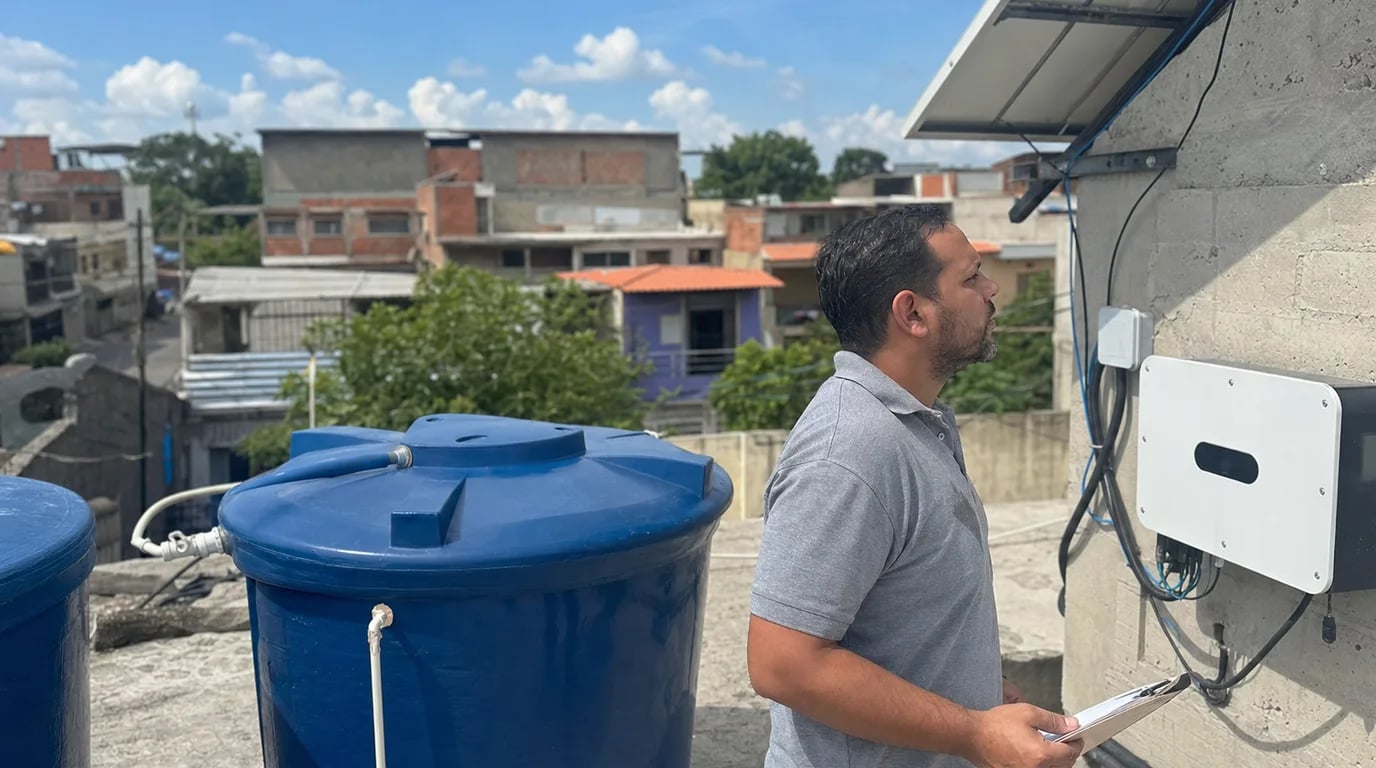
Water and power: the 8 things you really must check before buying in Venezuela
By HabitaOne Team
Guides from abroad tell you to inspect the kitchen and admire the view. Here that barely matters. What you check about water and power before you buy an apartment in Venezuela decides whether you move in with peace of mind or find out, keys already in hand, that the water runs one day and then skips two, that the tank is borrowed, and that every blackout leaves you in the dark for six hours. This is the list nobody publishes.
Nota legal
This guide is informational and does not constitute legal or technical advice. Before closing, consult a Venezuelan lawyer you trust, and for the electrical and plumbing side, a technician who inspects the property in person.
Why water and power rule the deal in Venezuela, not the kitchen
The question underneath isn't granite or hardwood, it's more basic: will this apartment give you water and power when you need them? Blackouts are frequent, and in the west almost daily; power rationing turned routine over the last decade, especially early in the year when reservoir levels drop. Zulia, Falcón, and Lara are the hardest hit. Water behaves the same way: in many areas it doesn't arrive every day, and a building with no way to store it runs dry the moment the supply stops.
That's why a buyer who knows doesn't walk in staring at the tile: they walk in turning taps, hunting for the tank, and asking what happens when the power goes out. The kitchen you can change later; water and energy, you can't.
Water: where it's stored, how it arrives, and at what pressure

The first four points. Water is a system: check it part by part.
1. Is there somewhere to store the water, and is it yours or shared?
How you tell whether an apartment has a water tank: don't take the seller's word for it. Find out whether the storage belongs to the unit or is shared by the building. The shared one splits the water among everyone, so if your ground-floor neighbor showers for an hour, you get less. Ask for the capacity in liters: a water tank for an apartment in Venezuela is what keeps you afloat the first day the supply gets cut.
2. How and how often does the water really arrive?
Does the water come through the mains every day, every other day, once a week? Or does the building depend on tanker trucks paid for separately? A huge tank is useless if the supply arrives so sporadically that it never fills. Talk to a neighbor or the doorman: they'll tell you the truth the seller rounds off.
3. Pressure: turn the tap on the floor where you'll live
This test separates the clueless buyer from the one who knows: you see a gorgeous apartment on a fifth floor, nobody turns a tap, and you move in to discover that at peak hour the shower is a trickle.
Pressure depends on the pumping, and the upper floors almost always get less. A hydropneumatic system —a pump that pressurizes the network— fixes that. Better pressure in an apartment almost always comes down to the pump: either the building already has a good one, or you install your own, and that costs a fortune.
The 30-second test
On the visit, turn on the kitchen tap and the shower on the highest floor at the same time and let them run for half a minute. A strong, steady stream is a good sign. If it drops to a trickle the moment you open the second tap, the pressure is weak. Always do it, even if it feels awkward. It's thirty seconds that save you a daily annoyance.
4. Make sure the water connection is active, not just that pipes exist
This sounds obvious and it isn't: pipes and taps don't mean the service is connected and current. In properties long vacant the service can be cut off, and reconnecting it drags in paperwork and inherited debts. Turn the taps, confirm water comes out today, and ask whether there's a debt with the water utility. To go deeper on the tank, the pump, and the pressure indoors, there's the guide on water at home: tank, pump, and pressure.
Power: generator, inverter, and how long the apartment lasts without Corpoelec

With water sorted, power is next, and it weighs just as much. Outages are part of the landscape, so what matters is what happens when it goes out, not just that it arrives.
5. Backup against blackouts: generator, inverter, or nothing?
There are three scenarios, and each changes the property's real value. One: there's no backup, and you sit in the dark like everyone. Two: an inverter with a battery bank that keeps a few points running (lights, fridge, modem, sometimes an AC unit). Three, more common in houses and good buildings: an electric generator on gasoline or diesel that sustains everything or close to it.
If there's an inverter, find out which circuits it covers and how many hours it lasts: one that powers two bulbs is nothing like one that keeps the fridge and an AC running. If there's a generator, confirm whose it is, who pays the fuel, and whether it works. An electric generator for a house in Venezuela is a big investment: having it installed adds real value; its absence is a future cost.
6. Make sure the power connection is active and debt-free
Same as with water: wires and bulbs don't guarantee service. Flip the lights on and ask about the meter: that it exists and doesn't carry a debt that could end in a cut. And note: an inverter is useless if the main feed is cut and there's no way to charge the batteries. Confirm the base service works before plan B.
7. Gas: piped, by cylinder, and an active connection
The third service people forget until they cook the first night. Find out how it arrives: piped directly, by cylinder, or through a central building system. Piped is convenient, but it has cuts and debts; the cylinder you have to get and refill, which in some areas is its own odyssey. Confirm the connection is active, not just that the pipe exists.
Condo solvency: the debt you inherit without knowing it

The point that can cost you the most money, and almost nobody checks it. Under horizontal property law, the common expenses (maintenance, cistern, pump, the building's inverter, doorman) are split among all the owners. If the previous owner stopped paying their share for months, that debt doesn't vanish when they sell.
8. Ask for the condo solvency certificate before you sign
The Horizontal Property Law is blunt about it. Its Article 13 establishes that the owner's obligation for common expenses "always follows ownership of the apartment or unit, even for expenses incurred before acquiring it." In plain terms: the debt stays attached to the property, and you buy whatever the previous owner failed to pay the condominium.
Condo debt travels with the property, not with the person. You buy the apartment and you also buy what the previous owner failed to pay.
So before you sign, demand the condo solvency certificate, the proof that the unit is current. If there's a debt, the seller pays it before closing or it comes off the price. Don't leave it for "later." Later, it's already yours. And if the seller dodges that document, it's a red flag.
This is also negotiating leverage
A condo debt, a missing inverter, or an old pump all work as arguments to bring the price down. You show up with the concrete fact ("no generator," "the condo is three months behind") and you negotiate over something real. Using these findings to negotiate and bring the price down can save you more than any repair.
Your checklist for the day of the visit

Show up with this list on your phone and don't let the living room dazzle you. The eight things, in order, that decide whether you'll live well or suffer:
- Water storage. Tank or cistern? The unit's own or shared? How many liters, how many days does it last?
- Water supply. How and how often does it arrive: mains every day, sporadic, or a tanker truck paid for separately?
- Pressure. Turn on the shower and kitchen taps on the highest floor at once. Firm stream or trickle? Is there a hydropneumatic pump?
- Active water connection. Does water come out today? Is there a debt with the water utility?
- Power backup. Generator, inverter, or nothing? If there's an inverter, what it covers and how many hours; if there's a generator, whose it is and whether it works.
- Active power connection. Flip the lights. Ask about the meter and any pending debts that could end in a cut.
- Gas. Piped, by cylinder, or central? Is the connection active?
- Condo solvency. Ask for the document proving the unit is current. The previous owner's debt, you inherit.
Checking these eight points costs no money: an attentive visit, a couple of awkward questions, and one document asked for in time. Skipping them does cost: in water that doesn't arrive, nights in the dark, and someone else's debt you pay. With your checklist clear, you can browse apartments for sale with different eyes. And before you part with the cash, go over the rest of the process of buying in dollars in Venezuela: you still have the documents and the notarization ahead, where more than one deal falls apart.
Fuentes
- Al Jazeera —
Power cuts are nothing rare in Venezuela: the nationwide blackout of August 2024 hit almost the entire country, in line with recurring events since 2019.
- Inter-American Dialogue —
Power rationing became routine over the last decade, especially in the first months of the year when reservoir levels drop.
- Ley de Propiedad Horizontal (Gaceta Oficial N° 3.241, 1983) —
Article 13 establishes that the obligation for common expenses always follows ownership, even for expenses incurred before acquiring it: the condo debt is inherited by the buyer.