
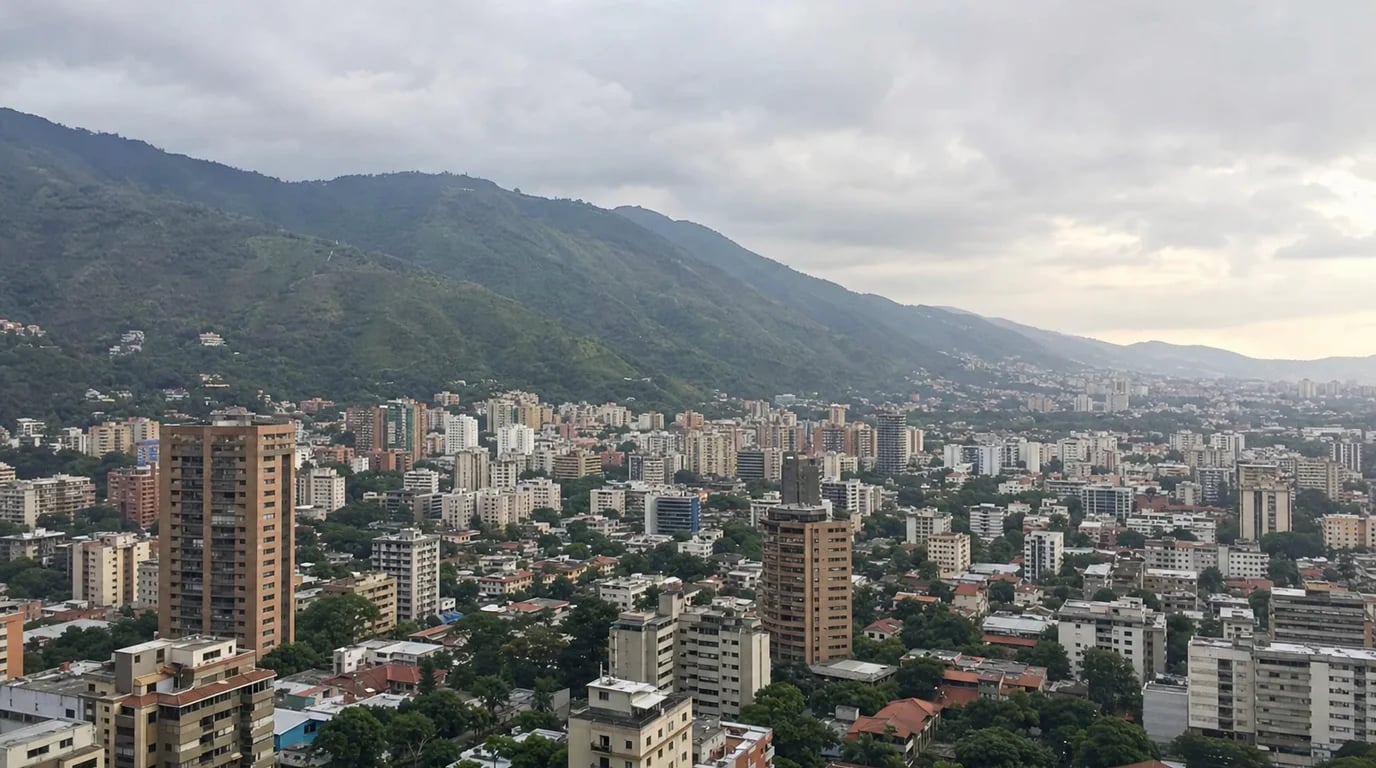
Price per m² in Caracas by area: from Catia to Chacao (2026 map)
By HabitaOne Team
Two apartments in Caracas, the same size, and one costs double the other. It isn't that one is better. They're in different areas. The price per square meter by area lets you compare them without size throwing you off, because it tells you what a meter of floor is worth wherever you look. Here's the full map, from Catia to Chacao, with real numbers and free.
This guide uses median dollar prices from active HabitaOne listings (June 2026), the same data that feeds our per-m² price page for Caracas. Other tools charge you or ask you to register for that figure; we publish it openly and broken down by area.
What the price per m² is (and why it matters more than the total)
The total price mixes two things worth separating: what a meter of floor is worth in that area, and how many meters it has. A $200,000 apartment can be a steal or a rip-off depending on whether it's 60 or 130 meters; the total figure, on its own, tells you nothing.
The price per m² fixes that. You divide the price by the meters and you're left with a figure you can compare across properties of any size. To know whether an area is expensive or cheap, you look at the meter, not the ticket.
Why the median and not the average
This is the part that makes the number trustworthy, and almost nobody explains it. We don't use the average of the prices. We use the median.
The average gets distorted by the extremes. A single penthouse listed at $8,000/m² among a hundred normal apartments at $1,500 shoots the average up and stops representing what it costs to live there. The median is the middle value instead, and a couple of sky-high or giveaway listings don't move it.
The median is the price of the middle apartment. The luxury penthouse doesn't push it up and the rushed fire sale doesn't drag it down. It tells you what that area really costs.
So when you see "Chacao, $1,912/m²," that's the typical apartment in the area: the yardstick you'll use to compare the whole map.
The map of Caracas: from west to east
Caracas doesn't move at a single price. It has a gradient. The city's median across all property types sits at $1,091/m², and 80% of the listings fall in a band from $464 to $3,198/m². That band is huge on purpose: within the same city you find prices that multiply by seven from one end to the other.

Here's how the map sorts from cheapest to most expensive, with the median apartment per m² (active HabitaOne listings, June 2026):
- San Bernardino (center): $814/m².
- El Paraíso (center-west): $905/m².
- La Florida: $946/m².
- El Hatillo: $1,113/m².
- Baruta: $1,400/m².
- Los Palos Grandes: $1,824/m².
- Chacao: $1,912/m².
- Altamira: $2,345/m².
- Campo Alegre: $3,170/m².
- La Castellana: $4,143/m².
- Las Mercedes: $4,782/m².
Catia, the reference point for the working-class west, doesn't appear with a figure on purpose: our active listings have almost no apartments for sale there, and with so little data any number would be a mirage rather than a median. The floor of the map is set by San Bernardino and El Paraíso; at the other extreme, the premium east climbs to nearly $5,000 in Las Mercedes.
These are asking prices, not closing prices
All the figures are medians of the list price, not the price it's signed at. In a cash market the buyer almost always negotiates downward: read it as the starting point the conversation kicks off from, not as what you end up paying.
The premium east: why it costs what it costs
The most expensive areas all cluster in the east and southeast: Las Mercedes, La Castellana, Campo Alegre, Altamira, Chacao. It isn't coincidence or snobbery. That meter costs more because it's where what people pay for converges: proximity to offices and corporate hubs, high-end restaurants and shopping, a better sense of safety, and newer buildings. Las Mercedes takes it to the extreme: it stopped being a residential neighborhood and became the east's commercial and dining district, and that shows up in every meter.

What stands out is how fast the price drops when you move just a few kilometers. From Las Mercedes to Baruta, which is close by, the meter goes from $4,782 to $1,400: a third of the price for crossing into another area. That's exactly why the price per m² by area is so useful: you're not comparing Caracas with Maracaibo, but neighboring areas where the same apartment is worth triple depending on which side of the avenue it's on.
How to use the number to avoid overpaying
This is where the figure turns into money in your pocket: the median per m² of your area is your negotiating yardstick. Before looking at an apartment, find the median for its area in the per-m² price finder. Divide the asking price by the property's meters and compare. If they're asking $2,600/m² in an area whose median is $1,900, it's not necessarily a rip-off, but you already know you're above the typical and have something to argue the price down with. If they're asking $1,600, it's worth a closer look.

The thirty-second calculation
Asking price divided by the apartment's square meters: that's the price per m² of THAT property. Compare it with the area's median. If it's well above, ask them to justify the difference: is it remodeled, does it have a better view, a high floor? If there's no clear reason, there's your room.
Some things the number doesn't capture you adjust by eye: the apartment's condition, the floor, the view, and the building's age move the price within the same area. The median is your anchor, not your verdict. To understand what makes an area "worth" its price (amenities, connectivity, atmosphere), cross this map with the guide to the best areas to live in Caracas.
One apartment, three different areas
To make the gradient less abstract, picture the same 80-square-meter apartment and multiply each area's median by those 80 meters. It's a hypothetical exercise on the published medians, not a real listing, but the math is the same one you'd do yourself.
152,960USD
80 m² in Chacao ($1,912/m²)
253,600USD
80 m² in Campo Alegre ($3,170/m²)
382,560USD
80 m² in Las Mercedes ($4,782/m²)
1,091USD/m²
Caracas median (all types)
The same apartment, the same floor plan, the same 80 walls, and between the low and high ends of this sample there's a $230,000 difference. The only thing that changed was the address. That's why in Caracas the area rules over any other variable, and why looking at the total price without looking at the meter is buying blind.

With your area and your reference number, look at what's being sold and check the listed prices against that median. If most of them are close, your reference is solid; if they're asking quite a bit more, you already know there's room to negotiate.
Fuentes
- International Business Times (cable de AFP) —
With no mortgage banking, residential real estate in Venezuela is bought in cash and in dollars, the only accepted means of payment in property transactions. That's why prices are quoted and compared in USD per square meter.
- Redfin —
The median isn't distorted by extreme values the way the average is: it marks the point where half the properties are asked above and half below, so it better reflects a market's typical price.