
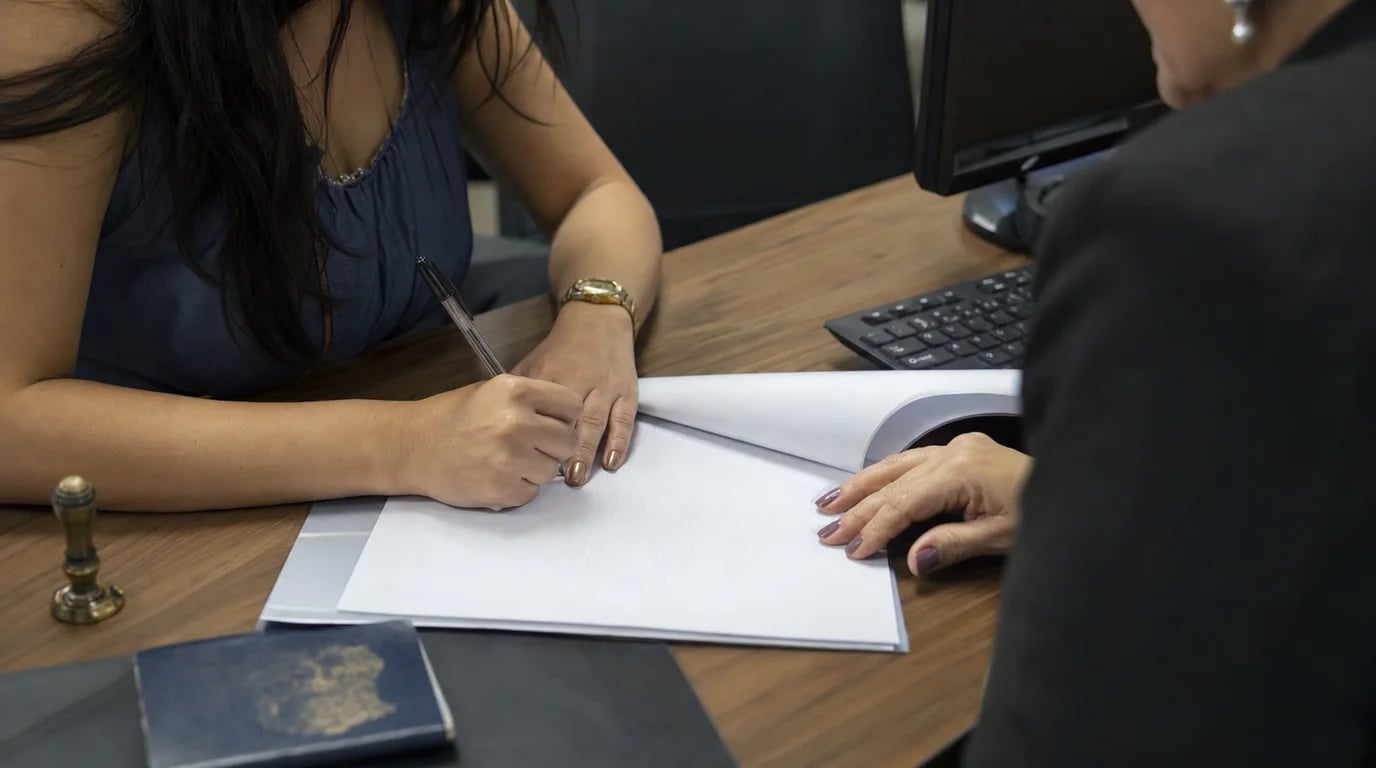
How to sell your home in Venezuela from abroad (power of attorney and apostille, step by step)
By HabitaOne Team
You left years ago, and the apartment stayed behind in Venezuela. Now you want to sell it, but you're not about to get on a plane just to go sign. You don't have to. A power of attorney to sell a property lets someone you trust sign in your place. The catch is that this same document is the key to your home, and if you hand it to the wrong person, you've already given the house away. This guide is so you can sell from a distance without that happening to you.
The real fear isn't the paperwork. It's getting robbed from 5,000 miles away, with no way to look over their shoulder and see what they signed: the agent who sells and disappears with the money, the "cousin" who signs at an inflated price and pockets the difference. What matters here isn't only which document you grant, but to whom, how you separate the person who signs from the person who verifies, and how you make sure the money actually reaches you.
Nota legal
This guide is informational and does not constitute legal advice. Every consulate and every registry has its own particulars. Before granting a power of attorney or closing a sale, consult a Venezuelan lawyer you trust.
the special power of attorney to sell a property in Venezuela: what it has to say

Start with the difference between two kinds of power of attorney, because half your safety rides on it. The Venezuelan Civil Code governs the mandate in article 1684: it's the contract by which someone acts on another's behalf. From there come two versions. A general power of attorney hands over broad authority across many of your affairs. A special one is granted for a single, concrete act, in this case selling that property. Don't give anyone a general power of attorney "to take care of everything." The law requires a special one to sell, and that limit is your protection, not a box to tick.
A well-drafted special power of attorney says exactly what your agent can do and nothing more. It should describe the property (address, registry details), authorize them to sell, and let them sign the purchase-and-sale option and execute the final document at the registry. And it should make clear, carefully, whether they can receive the price or not. That last sentence is the one that decides how much your own agent can take you for.
What a special power of attorney should not have
Be wary of anyone pushing you to sign a broad power of attorney "just in case," with authority to donate, to set the price at their discretion, or to move the money freely. The broader the power of attorney, the less control you keep. Ask your lawyer to draft one that says only what's necessary.
apostille or consularization: which one applies to you

Here's the question that tangles up the diaspora the most. You have two ways to grant the power of attorney from abroad, and they're mutually exclusive: you use one or you use the other.
The first is to sign the power of attorney before a notary in the country where you live, Spanish, American, whichever. Since that notary is foreign to Venezuela, their signature needs an international seal to validate it: the apostille. Venezuela is a party to the Hague Convention, so that seal, placed by the competent authority of the country where you signed, makes your power of attorney valid over there with no further legalizations. You sign, you apostille, and off it goes.
The second is to grant the power of attorney at the Venezuelan consulate or embassy in the country where you are. The consular officer acts as a Venezuelan notary: the document is born as a valid act in Venezuela, and for exactly that reason it doesn't get apostilled. The apostille is for foreign documents that need validating; one granted at your own consulate is already Venezuelan from the start.
The mistake that keeps repeating
Don't grant the power of attorney at the consulate thinking you'll apostille it afterward. You can't, and you don't need to: the consular power of attorney is already valid as is. The apostille belongs only to the foreign-notary route. Pick one of the two and follow it to the end.
Which one suits you? If you have a consulate nearby and can get an appointment, you save yourself the apostille. If it's far away or backed up, the local notary tends to be faster. Either route may require an additional registration in Venezuela depending on the municipality; your lawyer confirms that.
who you give the power of attorney to (and how to separate them from whoever verifies)

This is the most important decision in the whole guide, ahead of the type of power of attorney or the apostille. Who do you hand the key to?
The intuitive answer is "someone you trust": a relative, a lifelong friend. But trust alone isn't enough of a defense. The temptation for someone who gets a whole house put in their name is real, and even the most honest person can slip in front of a slick buyer. A good structure doesn't ask anyone to be a saint. It spreads the risk.
The principle is simple: the same person shouldn't sign and verify. If your agent signs, have an independent Venezuelan lawyer review the documents, the buyer's standing and the terms of the contract. That way, if the agent wants to close a shady sale, there's a second pair of eyes that doesn't answer to them. And since that lawyer doesn't hold the signature, they can't sell on their own either. No single point of failure controls the whole transaction.
The person holding the power of attorney shouldn't be the one verifying the documents or receiving the money. Split those roles, and no single person, on their own, can rob you.
To choose them, ask for real references, not impressions. If it's a fixer or a lawyer, confirm they're registered with their bar association and that they've closed deals you can verify. And be wary of haste: the one rushing you to grant the power of attorney "before the sale falls through" almost always has something they don't want you looking at calmly.
how you get paid without getting robbed

This is where most distance sales that end badly fall apart. The property sells, fine, but how does the money reach your account without getting lost along the way?
First, have the buyer pay you directly. In a dollar sale, the cleanest path is an international transfer to your account outside Venezuela, coordinated against the signing. Letting the money pass through your agent's hands is exactly the risk you want to avoid. If you draft the power of attorney so they can sign but not receive the price, you take away the very point where most scams happen.
The second is the golden rule: the money comes in before your agent executes the final document. In Venezuela the buyer becomes the owner when the sale is recorded at the Public Registry of the municipality where the property sits, not before. Until that happens, the house is still yours, and that's your leverage. There's no bank escrow here like in other countries, so the fit between payment and signing is coordinated by your lawyer, in writing.
The right order for the money
The sequence that protects you is: the buyer transfers to your account, you confirm the money arrived, and only then does your agent sign the recording. Never the other way around. Releasing the signature before payment is handing over the house with a piece of paper in between.
And mind the currency. The market moves in dollars and in cash, just like when you buy a property in dollars. Set which currency and which account you get paid into, put it in writing in the purchase-and-sale option, and treat anyone who insists on paying you in bolívares "at today's rate" or in installments with no date as a red flag.
the step by step from start to finish
This is the real order in which everything happens, from your living room abroad to the money in your account.
- Assemble the team: a trusted agent to sign and an independent Venezuelan lawyer to verify, who are not the same person.
- Get the documents in order. Your lawyer confirms the title is in your name, the standing certificates are current and there are no hidden liens. Better a problem shows up now than on signing day.
- Grant the special power of attorney by the route you chose, drafted solely to sell that property, with your lawyer reviewing the draft before you sign.
- Send it to Venezuela. Depending on the municipality, it may require a prior registration.
- Sell with backup: your agent signs the purchase-and-sale option, your lawyer reviews every term, and the currency and the receiving account are put in writing.
- Get paid and record, in that order. The buyer pays into your account, you confirm it, and only then does your agent execute the final document at the Public Registry. That's when it's official.
With the team assembled and the papers in order, you can list your property and see what offers come in before moving the power of attorney. And to sell it fast and for the best price, these tips for selling your home help the listing work from day one.
Fuentes
- Embajada de la República Bolivariana de Venezuela —
The mandate is defined in article 1684 of the Civil Code, and the special power of attorney is granted only for concrete acts such as the sale of a property, which can be executed before the consular section from abroad.
- Conferencia de La Haya (HCCH) —
Venezuela is a party to the Apostille Convention, which validates a foreign notarial act, such as a power of attorney signed before a local notary, so it's accepted in Venezuela.
- SAREN — Servicio Autónomo de Registros y Notarías —
Notaries give public faith to legal acts and transactions through their authentication, and expressly include powers of attorney among the acts they authenticate.
- SAREN — Servicio Autónomo de Registros y Notarías —
The Public Registry handles the recording and registration of acts relating to ownership and other property rights over real estate: the sale becomes official upon recording.